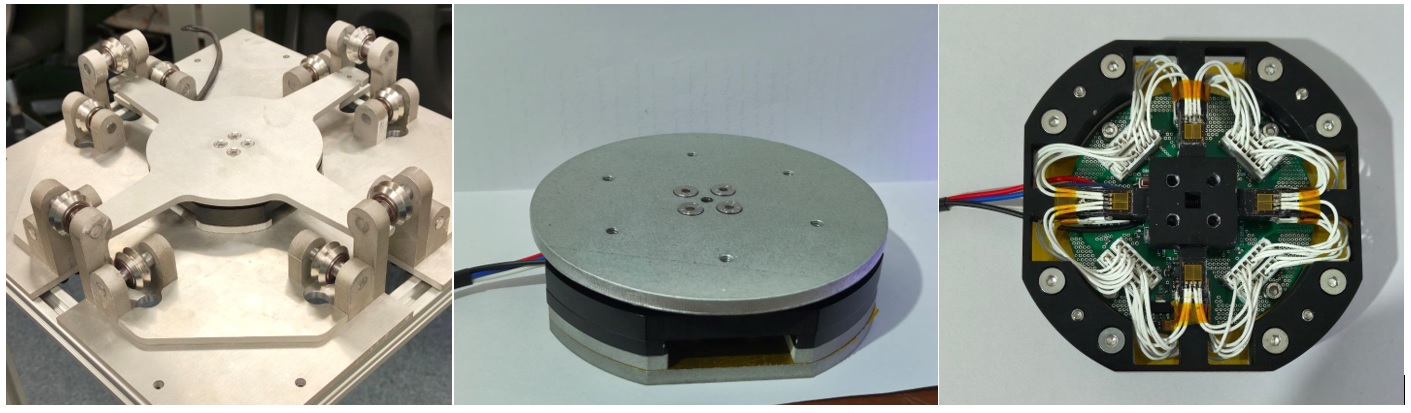
Development and application of force and tactile sensors for robot–environment interaction.
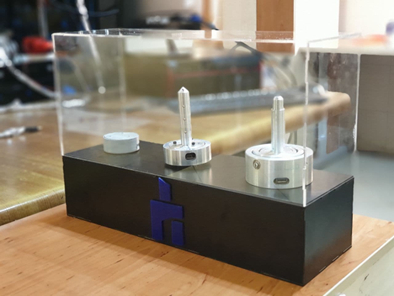
Rigid Force Sensor Based on the Hall Effect
The Human-Robot Interaction Laboratory at the University of Tehran is engaged in the development of advanced robotic systems capable of understanding, analyzing, and interacting efficiently with their surrounding environment. This laboratory focuses on fundamental challenges in robotic perception, object recognition, motion planning, and task automation. A key area of research is improving the physical interaction of robots with their environment through force and tactile sensors. In this regard, the development of intelligent sensing systems that can provide precise and real-time data on applied forces and contact points plays an important role in enhancing the efficiency and accuracy of robots. Force and tactile sensors, in addition to helping with the 3D perception of scenes and identifying relationships between objects, are also effective in controlling applied forces to prevent damage to delicate objects and improve safety in robotic processes. Force and tactile sensors are crucial in improving the performance and interaction of robots with their environment. These applications include the following:
-
Handling and Moving Delicate Objects: Force sensors allow robots to adjust the amount of force applied when handling delicate or sensitive objects (such as glass lamps or fruits), preventing potential damage.
-
Slip Detection: One of the challenges in gripping objects is preventing sudden slipping. Tactile sensors measure changes in contact force, enabling slip detection and allowing the robot to stabilize the object by adjusting its grip force.
-
Optimal Force Adjustment for Gripping Objects: Force sensors help robots adjust the necessary grip force for each object according to its weight, texture, and surface friction, ensuring that it is neither too tight (which could cause damage) nor too weak (which could lead to slipping).
-
Multiaxial Force Measurement: Force sensors with multiple degrees of freedom, such as six-axis sensors, can measure forces and torques from all directions, enabling more precise control of robot movements in complex interactions.
-
Adapting Robot Grips for Irregular or Sensitive Objects: Some objects have asymmetrical shapes or flexible surfaces, making them difficult to handle. Force and tactile sensors help robots adjust their grip based on tactile feedback, optimizing the distribution of contact forces.
Research in the Human-Robot Interaction Laboratory at the University of Tehran
Current research in the Human-Robot Interaction Laboratory at the University of Tehran focuses on force and tactile sensors, including the development of soft tactile sensors based on data fusion and six-degree-of-freedom force sensors.
-
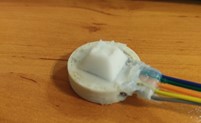
Soft Tactile Sensors: These sensors are designed using flexible materials and can provide accurate data on contact forces across large surfaces. This technology can be used to improve object handling and perform delicate tasks such as small part assembly and biological object manipulation.
-
Six-Degree-of-Freedom Force Sensors: These sensors measure forces and torques in all directions, enabling precise control of interaction forces. This technology is used in applications such as surgical robots, rehabilitation, and advanced industrial assembly.
Overall, the research conducted in this laboratory aims to develop advanced sensing systems that enhance the ability of robots to understand and optimally utilize physical forces. These technologies not only make robotic interactions smarter and more efficient but also represent an important step toward improving robot safety, accuracy, and adaptability to changing environments.
Projects:
-
Obstacle avoidance for dynamic-bed robots with a tactile intermediary in the framework of model-based predictive control.
-
Control and dynamic identification of a three-degree-of-freedom independent parallel mechanism (tripteron) and the construction of a human-robot interaction interface.
-
Design and construction of artificial skin tactile sensors for controlling a three-degree-of-freedom parallel robot for safe human-robot interaction.
-
Identification and control of a three-degree-of-freedom parallel robot and force sensor construction for human-robot interaction.
-
Design and construction of Hall-effect-based force sensors.
-
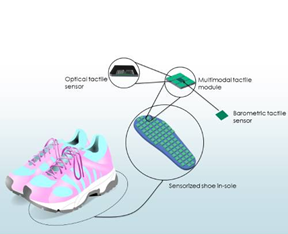
Design, construction, and data analysis of a smart shoe insole using soft tactile force sensors based on barometers.
-
Design and construction of a flexible shoe insole for human movement analysis using pressure sensor networks.
Faculty Members:
-
Dr. Mahdi Taleb Masouleh
-
Dr. Ahmad Kalhor
-
Dr. Mohammadreza Niri
Collaborating Units:
-
Human-Robot Interaction Laboratory, University of Tehran
Selected Papers:
- Sharifzadeh, Mohammad, Mehdi Tale Masouleh, and Ahmad Kalhor. "Design, construction & calibration of a novel Human-Robot Interaction 3-DOF force sensor." In 2015 3rd RSI International Conference on Robotics and Mechatronics (ICROM), pp. 182-187. IEEE, 2015.
- Sharifzadeh, Mohammad, Mehdi Tale Masouleh, and Ahmad Kalhor. "On human–robot interaction of a 3-DOF decoupled parallel mechanism based on the design and construction of a novel and low-cost 3-DOF force sensor." Meccanica 52 (2017): 2471-2489.
- Shayan, Amir Mehdi, Arman Khazaei, Amin Hamed, Arsalan Amralizadeh, and Mehdi Tale Masouleh. "ShrewdShoe, a smart pressure sensitive wearable platform." In 2018 6th RSI International Conference on Robotics and Mechatronics (IcRoM), pp. 458-463. IEEE, 2018.
- Hamed, Amin, Mehdi Tale Masouleh, and Ahmad Kalhor. "Design & characterization of a bio-inspired 3-dof tactile/force sensor for human-robot interaction purposes." In 2018 6th RSI International Conference on Robotics and Mechatronics (IcRoM), pp. 488-493. IEEE, 2018.
- Hamed, Amin, and Mehdi Tale Masouleh. "Design and Prototyping of One Degree-of-Freedom Rehabilitation Robotic Arm with Variable Weights." In 2019 7th International Conference on Robotics and Mechatronics (ICRoM), pp. 519-525. IEEE, 2019.
- Hajshahvaladi, Leila, Arsalan Amralizadeh, Amin Hamed, Hamed Nazemi, and Mehdi Tale Masouleh. "Design and fabrication of a low cost optical tactile sensor." In 2019 7th International Conference on Robotics and Mechatronics (ICRoM), pp. 217-222. IEEE, 2019.
- Shayan, Amir Mehdi, Arman Khazaei, Amin Hamed, and Mehdi Tale Masouleh. "Design and development of a pressure-sensitive shoe platform for nao h25." In 2019 7th International Conference on Robotics and Mechatronics (ICRoM), pp. 223-228. IEEE, 2019.
- Hamed, Amin, Mehdi Tale Masouleh, and Ahmad Kalhor. "Design & characterization of a bio-inspired 3-DOF Tactile/Force sensor and implementation on a 3-DOF decoupled parallel mechanism for human-robot interaction purposes." Mechatronics 66 (2020): 102325.
- Amralizadeh, Arsalan, Trifa Marjani, Mehdi Tale Masouleh, and Ahmad Kalhor. "Design and fabrication of a flexible pressure-sensitive insole based on barometric tactile sensors." In 2020 28th Iranian Conference on Electrical Engineering (ICEE), pp. 1-5. IEEE, 2020.
- Shayan, Amir Mehdi, Arman Khazaei, Amin Hamed, Arsalan Amralizadeh, and Mehdi Tale Masouleh. "Design and development of ShrewdShoe, a smart pressure sensitive wearable platform." International Journal of Robotics, Theory and Applications 6, no. 1 (2020): 1-10.
- Zargarbashi, Fatemeh, Hamed Nazemi Harandi, Amin Hamed, and Mehdi Tale Masouleh. "An Experimental Study on the Design & Construction of a Torque Measurement Unit with Tactile Sensors." In 2020 28th Iranian Conference on Electrical Engineering (ICEE), pp. 1-5. IEEE, 2020.
- Nasab, Seyed Danial Moosavi, Arman Beiranvand, Mehdi Tale Masouleh, Fariba Bahrami, and Ahmad Kalhor. "Design and development of a multi-axis force sensor based on the hall effect with decouple structure." Mechatronics 84 (2022): 102766.
- Ehsani, Amirhossein, Navid Asadi Khomami, Meysam Ghaneie, and Mehdi Tale Masouleh. "Design and Fabrication of an Optimized Six-Axis Force-Torque Sensor." In 2023 11th RSI International Conference on Robotics and Mechatronics (ICRoM), pp. 598-605. IEEE, 2023.
Results:
|
Rigid force sensor and soft force sensor |
Rigid force sensor based on the Hall effect |
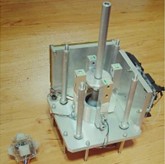
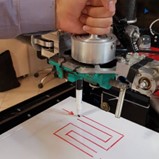
|
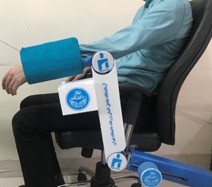
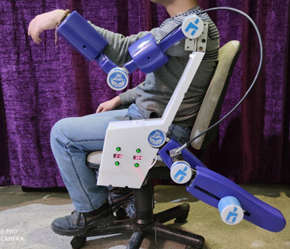
Rehabilitation device designed in the Human-Robot Interaction Laboratory |
Prototype of a rehabilitation device |
|
Smart shoe sensor |
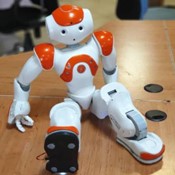
Smart shoe for stability control of the Nao humanoid robot |
|
Six-axis force sensor |
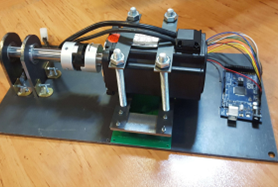
Torque measurement system for the motor |
|
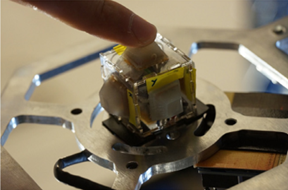
Six-degree-of-freedom force sensor with calibration setup |
|
|
Prototype of a soft tactile force sensor |