
Robotic object manipulation using fingered robots powered by artificial intelligence algorithms
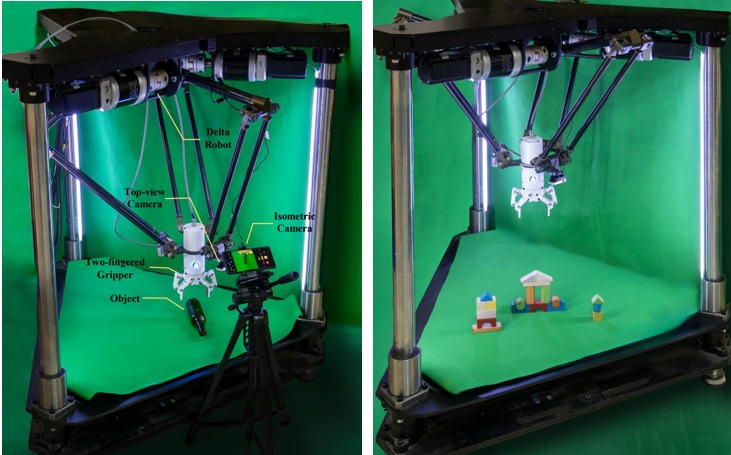
The Human–Robot Interaction Laboratory at the University of Tehran focuses on the development of intelligent robotic systems capable of perceiving, interacting with, and efficiently organizing their environment. Research in this field addresses key challenges related to robotic perception, scene understanding, and task automation, with the aim of providing innovative solutions to enhance robot performance in complex environments. The main objective of these investigations is to improve robot capabilities in 3D scene understanding, object relationship recognition, motion planning, and task execution. As the robot-environment interaction process involves four sequential steps (shown in Figure 1), the areas of scene analysis, recognition, and robotic task execution become crucial. Therefore, considering the goal of scene reconstruction, which is a common topic in robotics challenges and competitions, all these stages are evaluated. The main topics of research in this area are as follows:
1. Scene Reconstruction and Rearrangement
One of the significant challenges in robotics is the ability to understand and reconstruct 3D scenes for analyzing object layouts and predicting necessary changes. This section focuses on the development of algorithms that can use RGB-D or point cloud data to create an accurate representation of the environment and extract the required changes for object rearrangement. Additionally, machine learning, graph-based methods, and reinforcement learning techniques are explored to optimize movement and reduce energy consumption during the rearrangement process.
2. Robotic Object Pickup and Manipulation
Object pickup and manipulation are fundamental tasks in robotics, requiring a combination of computer vision, machine learning, and precise control. This section investigates various methods to improve the object pickup process, including the use of geometric methods, deep neural networks for estimating optimal grasping points, and hybrid techniques to enhance accuracy and stability in object manipulation. These studies are tested in both simulated and real-world environments to achieve optimal performance.
3. Task Planning and Optimization
One of the major challenges in robotic task execution is optimal motion planning and determining the correct sequence of actions. This section applies artificial intelligence-based methods, including reinforcement learning, graph neural networks, and optimization search techniques, to design more efficient movement paths for robots. These methods help robots perform complex multi-step tasks with minimal computational cost and maximum accuracy.
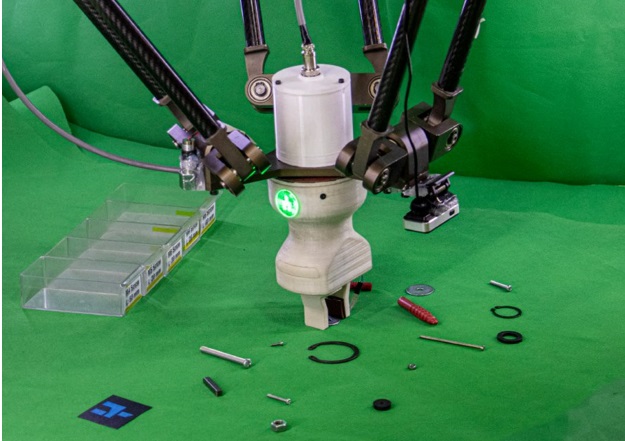
These research studies have applications in various fields, including domestic robots, industrial robots, and automation systems. For example, in home environments, robots can be used for object organization and performing everyday tasks, while in industrial settings, they can optimize assembly processes and material handling. Diverse applications such as chessboard arrangement, food packaging, electronic component separation, scene rearrangement, and similar tasks have been tested.
By integrating modern computer vision, deep learning, and motion planning techniques, the laboratory aims to develop robots capable of operating autonomously in dynamic and complex environments. The focus on precise perception, optimal planning, and effective task execution enables the enhancement of robotic system performance across various domains.
Projects:
-
Robotic object grasping position and orientation recognition for fingered grippers using deep neural networks
-
Domestic activity completion with a two-finger robotic hand using deep reinforcement learning
-
Interactive object pickup by mimicking human actions with a two-fingered robot
-
Object pickup using graph neural networks
-
Grasping unknown objects with a two-fingered robot using reinforcement learning techniques
-
Pickup and placement of a specific geometric object for packaging using a two-fingered robot, aided by image processing and deep networks
-
Object recognition using image processing algorithms and machine learning for pick-and-place operations with a Delta robot
-
Data collection and model development for targeted object pickup in specific tasks based on imitation learning from human behavior using a two-fingered robot
-
Object grasping with a three-fingered robot using deep learning algorithms
-
Practical implementation of automated chessboard arrangement using a Delta parallel robot and deep learning
Faculty Members:
-
Dr. Mehdi Tale Masouleh
-
Dr. Ahmad Kaleh
Collaborating Unit:
-
Human–Robot Interaction Laboratory, University of Tehran
Selected Publications:
-
Hosseini, Hamed, Mehdi Tale Masouleh, and Ahmad Kalhor. "Improving the successful robotic grasp detection using convolutional neural networks." In 2020 6th Iranian Conference on Signal Processing and Intelligent Systems (ICSPIS), pp. 1-6. IEEE, 2020.
-
Sabzejou, Ali, Mehdi Tale Masouleh, and Ahmad Kalhor. "2D Skeleton-Based Keypoint Generation Method for Grasping Objects with Roughly Uniform Height Variation." In 2023 11th RSI International Conference on Robotics and Mechatronics (ICRoM), pp. 847-853. IEEE, 2023.
-
Babi, Zeynab Ezzati, Navid Asadi Khomami, Mehdi Tale Masouleh, and Ahmad Kalhor. "Autonomous Robotic Assembly and Sequence Planning Based on YOLOv8." In 2023 11th RSI International Conference on Robotics and Mechatronics (ICRoM), pp. 840-846. IEEE, 2023.
-
Moghadam, Ali Rashidi, Mehdi Tale Masouleh, and Ahmad Kalhor. "Grasp the Graph (GtG): A Super Light Graph-RL Framework for Robotic Grasping." In 2023 11th RSI International Conference on Robotics and Mechatronics (ICRoM), pp. 861-868. IEEE, 2023.
-
Balazadeh, Elnaz, Mehdi Tale Masouleh, and Ahmad Kalhor. "Hugga: Human-like grasp generation with gripper’s approach state using deep learning." In 2023 11th RSI International Conference on Robotics and Mechatronics (ICRoM), pp. 854-860. IEEE, 2023.
-
Roudbari, Asal, Mahdi Dalvand, Navid Pasiar, Navid Asadi, Mohammad Yousefi, and Mehdi Tale Masouleh. "Autonomous Vision-based Robotic Grasping of Household Objects: A Practical Case Study." In 2023 11th RSI International Conference on Robotics and Mechatronics (ICRoM), pp. 918-924. IEEE, 2023.
-
Yarmohammadi, Parsa, Navid Asadi Khomami, Mehdi Tale Masouleh, and Mohammad Reza Zakerzadeh. "Experimental study on chess board setup using delta parallel robot based on deep learning." In 2023 11th RSI International Conference on Robotics and Mechatronics (ICRoM), pp. 869-875. IEEE, 2023.
-
Yourdkhani, Reihaneh, Arash Tavoosian, Navid Asadi Khomami, and Mehdi Tale Masouleh. "Experimental Study on Automatically Assembling Custom Catering Packages With a 3-DOF Delta Robot Using Deep Learning Methods." In 2024 32nd International Conference on Electrical Engineering (ICEE), pp. 1-7. IEEE, 2024.
-
Beigy, AliReza, Mehdi Tale Masouleh, and Ahmad Kalhor. "Explorable Grasp Pose Detection for Two-Finger Robot Handover." In 2024 32nd International Conference on Electrical Engineering (ICEE), pp. 1-7. IEEE, 2024.
-
Naeinian, Fatemeh, Elnaz Balazadeh, and Mehdi Tale Masouleh. "Mapping human grasping to 3-finger grippers: A deep learning perspective." In 2024 32nd International Conference on Electrical Engineering (ICEE), pp. 1-7. IEEE, 2024.
-
Mojtahedi, Mona Mohades, Arvin Mohammadi, and Mehdi Tale Masouleh. "Experimental study on autonomous food packaging with delta parallel robot and two fingered gripper." In 2024 32nd International Conference on Electrical Engineering (ICEE), pp. 1-6. IEEE, 2024.
-
Saadati, Anushe, Mehdi Tale Masouleh, and Ahmad Kalhor. "Deep learning-based imitation of human actions for autonomous pick-and-place tasks." In 2024 32nd International Conference on Electrical Engineering (ICEE), pp. 1-7. IEEE, 2024.
-
Ghasemi, Seraj, Hamed Hosseini, MohammadHossein Koosheshi, Mehdi Tale Masouleh, and Ahmad Kalhor. "Scene understanding in pick-and-place tasks: Analyzing transformations between initial and final scenes." In 2024 32nd International Conference on Electrical Engineering (ICEE), pp. 1-7. IEEE, 2024.
-
Hosseini, Hamed, Mohammadhossein Koosheshi, Mehdi Tale Masouleh, and Ahmad Kalhor. "Multi-modal robust geometry primitive shape scene abstraction for grasp detection." IEEE Access (2024).
-
Barghi, Arman, Navid Pasiar, Mehdi Tale Masouleh, and Ahmad Kalhor. "From Bricks to Bots: Automated Collision-Aware Sequence Planning for LEGO Reconstruction with a Two-Finger Gripper." In 2024 10th International Conference on Control, Instrumentation and Automation (ICCIA), pp. 1-6. IEEE, 2024.
-
Yousefi, Mohammad, Mahdi Dalvand, Navid Asadi Khomami, Mehdi Tale Masouleh, and Mohammad Reza Haeri Yazdi. "Robotic Sorting of Mechanical and Electrical Parts: An Autonomous Vision-Based Approach in a Practical Case Study." In 2024 10th International Conference on Control, Instrumentation and Automation (ICCIA), pp. 1-6. IEEE, 2024.
Results:
Project Videos